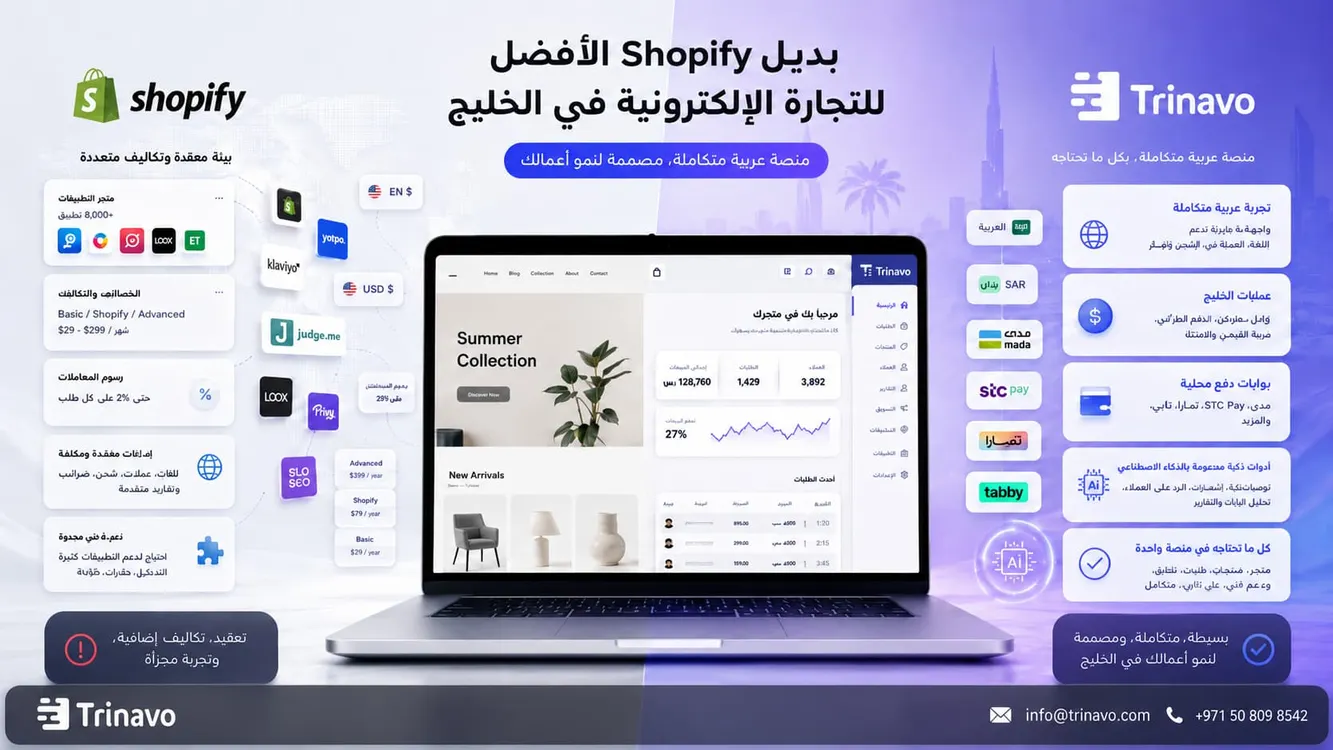
Looking for a Shopify alternative? Compare Shopify and Trinavo on price, commissions, Arabic support, RTL, and payment to find the best fit for your Arab store.
Today there are many e-commerce platforms that help you build your store quickly, and among them is Shopify, one of the most popular platforms worldwide. But a platform's popularity doesn't always mean it's the right fit for every merchant. The Arab merchant doesn't just need an online store that works — they need a selling experience their customer understands from the very first moment.
The real question isn't: is Shopify a powerful platform?
It's: does it really suit the Arab market?
Here begins the search for a Shopify alternative that's closer to the nature of Arab stores — not only in price, but in ease of launch, cost clarity, and customer experience.
That's why Trinavo stands out as an option worth comparing, because it combines a clearer Arabic experience, a lower cost, and easier store management.
Reasons to look for a Shopify alternative
Shopify may suit many stores around the world, but it doesn't fit every Arab merchant to the same degree. The problem usually shows up in actual use. That's when the merchant starts discovering details that weren't clear at first, such as the subscription cost, sales fees, and the store's need for apps or adjustments to look right for the Arab customer.
The top reasons that push a merchant to look for a Shopify alternative:
1. The monthly cost rising as the store grows.
2. Extra fees or costs tied to payment operations.
3. The need to configure Arabic and RTL direction.
4. Relying on external apps for some essential features.
5. The difficulty of providing a local, comfortable payment experience for the Arab customer.
The problem isn't Shopify's power itself, but how well it fits an Arab merchant who wants to launch a clear, fast store at a controllable cost. That's why Trinavo stands out as an option worth comparing, especially for a merchant who wants an easier Arabic platform, clearer cost, and a selling experience closer to their customer.
Shopify and Trinavo subscription pricing
The first number a merchant notices when comparing Shopify and Trinavo is the subscription price, yet that number alone isn't enough to judge the real cost. The Arab merchant isn't just looking for a famous platform — they're looking for a clear cost, an easy start, and an experience that suits the Arab market from day one.
Shopify's Basic plan in the UAE starts at $32 per month when paid monthly, or $24 per month when paid annually. Trinavo offers a simpler model for the Arab merchant, with a free plan to start and a Premium plan at $15 per month, or $160 with an annual subscription.
Item |
Shopify |
Trinavo |
Free start |
Short free trial |
Free plan, no credit card |
Lowest paid plan |
Basic |
Premium |
Monthly price |
$32 per month |
$15 per month |
Annual price |
About $288 |
$160 per year |
Cost before add-ons |
Higher over time |
Clearer and easier to start |
Best suited for |
A merchant who wants a broad global platform |
A merchant who wants an Arabic store at a lower cost |
The difference here is clear: Shopify may be a strong choice for someone who wants a broad global platform, but Trinavo gives the Arab merchant a lighter, lower-cost start, especially if they want to test a store idea before committing to higher subscriptions. So Trinavo may be closer to the cheapest Shopify alternative for a merchant focused on the Arab market who doesn't want to pay a high cost from the start.
Check Trinavo's pricing page
Payment gateway fees in Shopify and Trinavo
The subscription price isn't the only cost in Shopify. There are also Shopify fees tied to payment gateways, fees that may appear when using an external payment provider, plus the cost of apps or customization.
In the UAE, payment gateway fees may reach 2.9% + 1 AED per sale. Extra fees may appear when using an external payment provider, especially if Shopify Payments isn't available or suitable for the merchant.
Trinavo, on the other hand, offers an important advantage for the Arab merchant: it charges no platform commission on sales. This makes the cost clearer and gives the merchant a better ability to calculate their profit margin before launching the store, especially if they're looking for a Shopify alternative with no commission.
Learn more about payment gateways in Trinavo if you want to know which payment options can be connected to your store depending on the market you target.
Item |
Shopify |
Trinavo |
Payment gateway fees |
Apply depending on plan and country |
Depend on the payment gateway used |
Third-party provider fees |
May apply depending on the plan |
No platform commission |
Platform commission |
May apply in some cases |
0% on sales |
Cost clarity |
Requires adding up subscription, fees and add-ons |
Clearer for the beginner merchant |
Impact on profit |
May grow as sales increase |
Lighter in terms of platform commission |
Here Trinavo becomes more attractive to the Arab merchant, especially if they sell on a limited profit margin. Every percentage deducted from a sale can affect the final profit, particularly as the number of orders grows. So when comparing Shopify commissions with Trinavo's model, don't look only at the monthly subscription, but also at what's deducted from each sale.
A practical example
Let's assume your store makes $10,000 in monthly sales. If the payment gateway fee is just 2.9%, that means the variable-fee portion could reach $290 per month, before counting any fixed per-transaction fee or external provider fees.
Monthly sales |
Fee rate |
Approximate amount |
$10,000 |
2.9% |
$290 |
In this case, the question isn't: how much is the subscription? The more important question is: how much of your profit will remain after fees? This is where Trinavo's advantage shows more clearly. If the platform charges no commission on sales, that gives the merchant more room to control the profit margin, especially in new stores or stores that rely on a large number of orders.
Annual cost: Shopify vs Trinavo
When calculating the platform's cost over a full year, looking at the subscription price alone isn't enough. The merchant needs to add up the annual subscription, payment fees, app costs, and any extra settings related to Arabic or RTL direction.
Cost item |
Shopify |
Trinavo |
Annual subscription |
Starts at roughly $288 in the example above |
Free or $160 per year |
Payment fees |
Card fees, plus possible third-party provider fees |
No platform commission, only payment gateway fees |
Arabic and RTL |
May need settings, apps or theme adjustments |
Ready for the Arab market |
Additional apps |
Many of them are paid |
Built-in features depending on the plan |
Artificial intelligence |
May need extra tools or settings depending on usage |
AI Suite for products, SEO and categories depending on the plan |
Best for the beginner merchant |
Powerful, but can become costly |
Clearer and lighter to start with |
The annual savings with Trinavo are clear, especially if your store needs paid add-ons, RTL setup, or helper tools for products and SEO. So if you're looking for a lower-cost Shopify alternative, Trinavo deserves to be the first option you compare before committing to any other platform.
Shopify's problems in the Arab market
Shopify's global strength doesn't mean it's the easiest choice for every Arab store. The challenge usually appears when turning the store from a generic global front into an experience suited to the Arab customer in language, payment, and the way the order is presented.
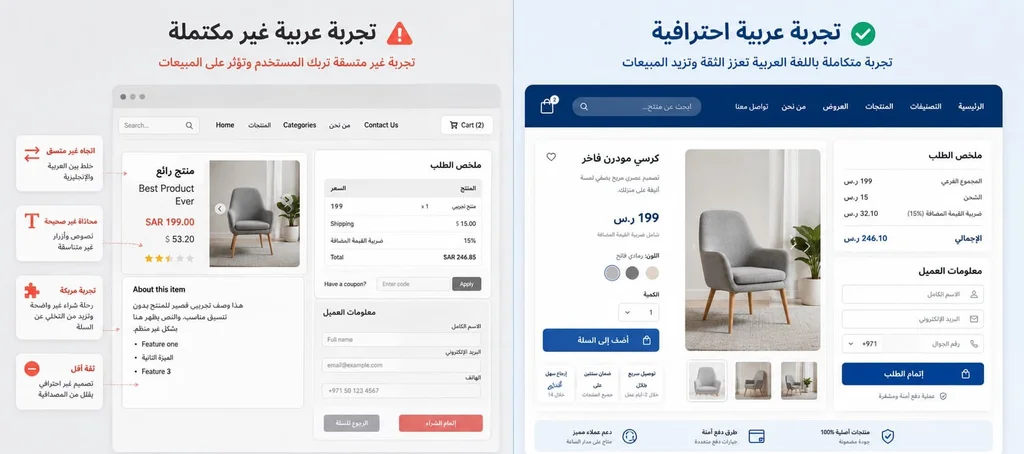
This particular point is what makes some merchants look for a Shopify alternative for Arabic stores, because the customer experience doesn't stop at the store's appearance — it includes the language, the cart, payment, messages, and how content is displayed.
A customer in the Arab market expects a clear experience from the start:
1. Natural Arabic language.
2. Right-to-left browsing direction.
3. A clear checkout page.
4. Familiar payment methods.
5. Order and shipping messages in Arabic.
6. A shopping experience that doesn't look partially translated.
Arabic and RTL in Shopify and Trinavo
Arabic language support doesn't just mean translating words. The Arab store needs a full experience that suits how the customer reads and browses. That's why Shopify problems with Arabic appear when the theme, the checkout page, or the mobile experience isn't fully prepared for the language and reading direction.
In Shopify, you can manage languages and translations, but reaching a complete Arabic experience may require extra settings, translation apps, a theme that supports RTL well, or technical adjustments in some cases. This is what makes some merchants specifically search for Shopify RTL Arabic to find out whether the store can be set up in Arabic without complexity.
Trinavo shortens this journey, because it's prepared for the Arab market from the start, with RTL support, multiple languages, and an experience closer to how the Arab customer browses.
Learn more about Trinavo's multi-language feature
Element |
Shopify |
Trinavo |
Arabic language |
Needs translation setup and management |
Supported within the platform experience |
RTL direction |
May need a suitable theme or customization |
Supported from the start |
Arab customer experience |
May need extra tuning |
Smoother for the Arabic store |
Need for apps |
Possible for translation or RTL |
Fewer at the start |
Ease of launch |
Needs more precise setup |
Faster for the Arab merchant |
In Shopify you may start with a global platform and then add Arabic later. In Trinavo, you start from a platform that understands Arabic and the needs of the Arab market from the ground up.
Payment gateways in Shopify and Trinavo
Payment is one of the most important stages of buying. A customer may like the product, add it to the cart, then leave if they don't find a payment method they trust or understand.
In the Arab and Gulf market, one payment gateway isn't enough. The merchant usually needs several options such as:
1. Card payments.
2. Cash on delivery.
3. Bank transfer.
4. Digital wallets.
5. Installment or buy-now-pay-later solutions.
6. Familiar local or Gulf payment gateways.
In Shopify, you may need an external payment provider if Shopify Payments isn't available or suitable for your country or business. This can add a new layer of setup and fees.
Trinavo, on the other hand, offers an important advantage for the Arab merchant: support for a wide range of regional and Gulf payment gateways such as:
· Moyasar, Paylink, Tabby, Tamara, PayTabs, Paymob, HyperPay, MyFatoorah and others.
Element |
Shopify |
Trinavo |
Local payment gateways |
May need a third-party provider depending on country |
Multiple Gulf and Arab gateways |
Installment options |
Depend on available integrations |
Supports solutions like Tabby and Tamara |
Payment methods management |
Needs setup per provider |
Options tailored for Arabic stores |
Customer experience |
May vary by setup |
Closer to Arab customer expectations |
Additional fees |
May appear with a third-party provider |
No platform commission on sales |
This makes Trinavo closer to the merchant selling in Saudi Arabia, the UAE, Kuwait, Qatar, Bahrain, Oman, or any Arab market that relies on local payment gateways.
Order completion and a clearer buying experience
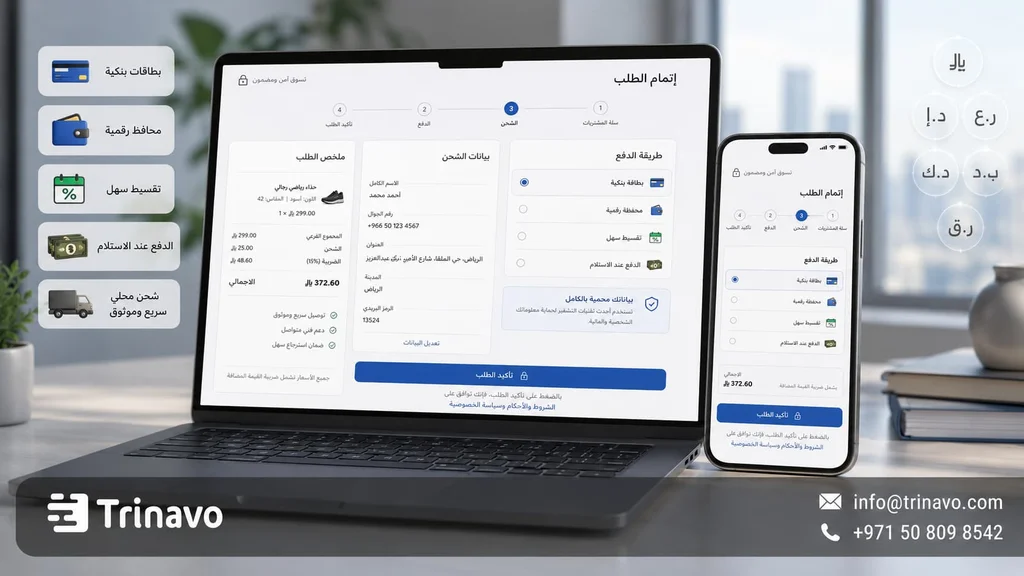
After choosing the right payment gateway, the checkout page itself matters; it's the stage where the customer decides to complete the order or leave the store. In the Arab market, the checkout page must be clear and comfortable, especially on mobile. The customer expects to see Arabic naturally, familiar payment methods, and understandable messages about shipping, cost, and delivery time.
Any small flaw at this stage can affect sales, such as:
1. Some texts appearing in English.
2. An unclear payment method.
3. No payment gateway the customer recognizes.
4. Difficulty entering data on mobile.
5. Unclear shipping cost.
6. Order messages not appearing in Arabic.
In Shopify, the checkout page is strong, but it may need extra settings or customizations to become fully suited to the Arab customer experience, especially on basic subscription plans. Trinavo makes the payment experience closer to the nature of the Arab market, through Arabic language support, local payment methods, and the ability to display payment method names and descriptions more clearly to the customer.
Trinavo's features for Arabic stores
Trinavo's strength as an Arabic e-commerce platform shows in the way it brings many of the Arab store's needs inside the platform itself, instead of leaving the merchant to look for them later through separate apps or settings.
This shows in several important points:
1. RTL support.
2. Support for more than 50 languages.
3. Multi-currency support.
4. Arab and Gulf payment gateways.
5. Built-in growth tools.
6. An experience suited to Arabic stores.
7. Easier setup for the beginner merchant.
Learn more about all Trinavo features if you want to compare the platform's built-in tools, such as product management, orders, payment, SEO, analytics, languages, and growth integrations.
These features don't mean the merchant won't need to set up their store carefully — they mean the start itself is easier, because the essentials the Arab market needs are within the platform instead of being searched for in external add-ons.
This is what makes Trinavo a strong choice for anyone looking for a Shopify alternative that isn't only cheaper, but also closer to the way selling works in the Arab market.
AI tools to improve your store's products
Managing a store doesn't stop at uploading products. The merchant needs clear titles, convincing descriptions, organized categories, and data that help customers and search engines understand the products.
Here Trinavo offers the AI Suite feature within the paid plan, including tools that help with:
1. Writing SEO content.
2. Improving product titles.
3. Creating clearer descriptions.
4. Generating Meta Titles and Meta Descriptions.
5. Enriching product data.
6. Filling in missing tags and attributes.
7. Suggesting a better category structure.
This feature helps the merchant reduce manual work, especially if they have a large number of products and need to organize them and improve their visibility quickly.
When should you choose Trinavo over Shopify?
Choose Trinavo as a Shopify alternative if your goal is to launch an Arabic store quickly, at a clearer cost, and without constant reliance on apps and customizations. But if you target a broad global market and have a budget for add-ons and developers, Shopify may be a suitable choice for you.
In the end, don't let a platform's fame be your only criterion. Try building your store, add your first products, test the payment, mobile, and category experience, then decide based on a clear, practical experience. And if you're looking for a simpler, lower-cost Shopify alternative for Arabs, Trinavo is your best choice.
Frequently asked questions about the Shopify alternative and Trinavo
Does Trinavo replace the essential Shopify apps I rely on?
It depends on the type of apps. Trinavo provides built-in features such as product management, orders, analytics, SEO, AI Suite, cart management, loyalty, referrals, multi-currency, payment gateways, and integrations. But if you rely on a very specialized Shopify app, such as advanced automation, a specific ERP integration, or a particular dropshipping app, check the integrations page or contact the Trinavo team before migrating.
How do I move my products from Shopify to Trinavo without losing data?
Start by exporting the products from Shopify, then review the product names, images, categories, descriptions, prices, inventory, and tags. After that, arrange the file so it's ready for import, and make sure to keep important links or set up redirects for old pages if your store is established and gets traffic from Google. If you have a large catalog, historical orders, or many customers, it's best to contact the Trinavo team to determine the most suitable migration method before executing it.
Are Trinavo's prices fixed or could they rise in the future?
The prices currently published on the Trinavo page are $0 for the free plan, $15 per month for the Premium plan, and $160 per year for the annual option. However, like any SaaS platform, prices or features may change in the future depending on company policy. So review the pricing page before subscribing, and if you have a large store or special needs, request a clear quote from the sales team.
Does Trinavo support Dropshipping with AliExpress as Shopify does?
Trinavo's listing shows, within the dropshipping section, an AliExpress integration for importing products, and there's also a Special plan that includes Drop Shipping among its features for large stores. But dropshipping support doesn't mean every supplier, shipping method, or return policy will automatically be suitable. Before launching, check the supplier, shipping time, product quality, return policies, and the customer experience in your country.
What's the difference in SEO and loading speed between Shopify and Trinavo?
Shopify is a globally strong platform in technical infrastructure, and it provides essential tools and a large collection of SEO apps, while Trinavo focuses on supporting SEO within the platform with AI tools for writing titles, descriptions, and Meta tags, and improving categories. As for loading speed, it's affected by images, the theme, apps, scripts, hosting, and page size. So no platform guarantees SEO results just by subscribing; success depends on execution, content quality, store structure, and user experience.
Is the Trinavo Shopify alternative suitable for every Arab store?
The Trinavo Shopify alternative is more suitable for stores that target an Arab or Gulf audience and want a free or low-cost start, with Arabic and RTL support, local payment gateways, and built-in growth tools. But if the store targets many global markets and relies on very specialized Shopify apps, the merchant may need a deeper comparison before migrating.


