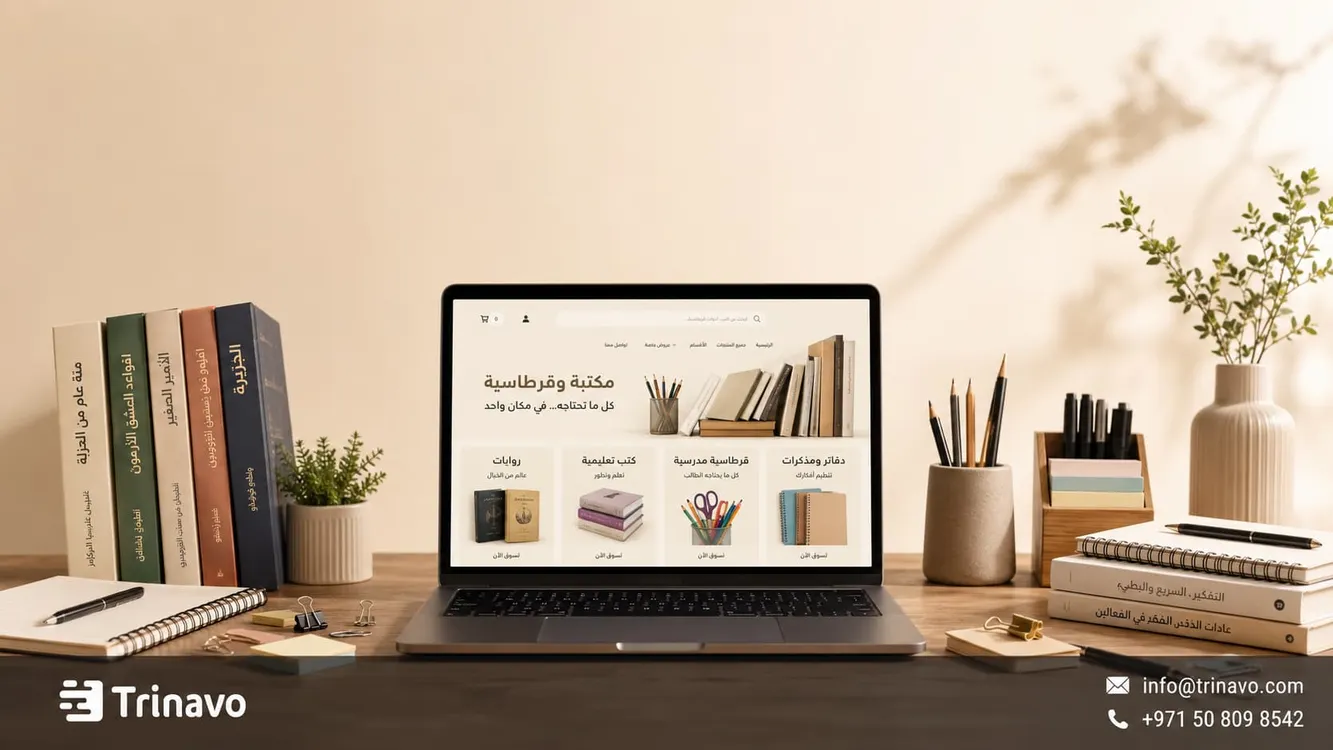
Create an online bookstore and stationery shop with Trinavo; organize books, stationery, inventory, and orders with flexible payment and delivery options.
When a customer enters an online bookstore, they may be looking for a new novel, a book for their child, a study reference, an elegant notebook, or a fitting gift for a reader who loves detail. The clearer the categories, the easier the search, and the more accurate the product descriptions, the more confident they feel about buying.
This is where the importance of creating an online bookstore and stationery shop comes in, with an organized experience that brings together books, printed materials, school supplies, office supplies, and cultural gifts in one place.
And with Trinavo, you can build a clear, easy-to-manage store that helps you organize products, track inventory and orders, and improve the buying experience from the first visit until the order arrives.
What Is an Online Books and Stationery Store?
An online books and stationery store is a digital platform that sells books and other educational products over the internet.
What distinguishes this type of store is that the customer doesn't always buy a product they already know. Sometimes they come to discover a new book, search for a particular author, look for a gift for a reader, or buy supplies for school, university, and work.
A books and stationery store may include categories such as:
|
Category |
Product Examples |
|
Printed Books |
Novels, self-development books, children's books, religious books, academic books |
|
E-books |
PDF, EPUB, digital guides, summaries, educational books |
|
Stationery |
Notebooks, pens, folders, stickers, organizing tools |
|
Educational Products |
Flashcards, practice workbooks, learning aids for children |
|
Reader Gifts |
Bookmarks, mugs, book bags, reading boxes |
|
Printed Materials |
Planners, schedules, custom notebooks, educational posters |
|
Office Supplies |
Desk organizers, paper, filing tools, work supplies |
The success of this store doesn't depend on the number of products alone, but on ease of search, clarity of categories, the quality of book descriptions, and a buying experience that lets the reader, the student, or the office owner reach what they need without complication.
Read also Free Arabic Online Store
Why Is Selling Books and Stationery Online a Good Opportunity?
A books and stationery store combines more than one buying pattern. The reader may return to buy a new title, the student buys during the school season, offices need periodic supplies, and publishers look for a direct channel to sell their releases without relying entirely on intermediaries.
Also, selling books online doesn't depend only on direct demand, but on discovery and recommendations. A customer may come to buy a single book, then add a notebook, a bookmark, a planner, or another book from the same category.
Grand View Research reports that the book market remains vast despite changing reading habits and the variety of content formats; the global book market was valued at USD 156.6 billion in 2025, and is expected to reach USD 162.6 billion in 2026 and then USD 215.9 billion by 2033, at a compound annual growth rate of 4.1%
As for the e-book market, Statista indicates that the revenue of the global eBooks market is expected to reach USD 15.14 billion in 2026. Likewise, Precedence Research indicates that the online books market was valued at USD 26.04 billion in 2025, and is expected to grow to USD 27.89 billion in 2026, then to USD 51.32 billion by 2035.
These figures don't mean that any online library will automatically succeed, but they show that digital selling of books and readable content is a real opportunity for those who offer a better search, categorization, and recommendation experience.
Elements of a Successful Books and Stationery Store Design
A successful online bookstore design doesn't just mean a beautiful appearance; the reader is a smart customer with specific requirements that drive their decision. To turn your store's visitors into loyal readers, the user experience must rest on four essential pillars:
Clear Search by Title, Author, and Category
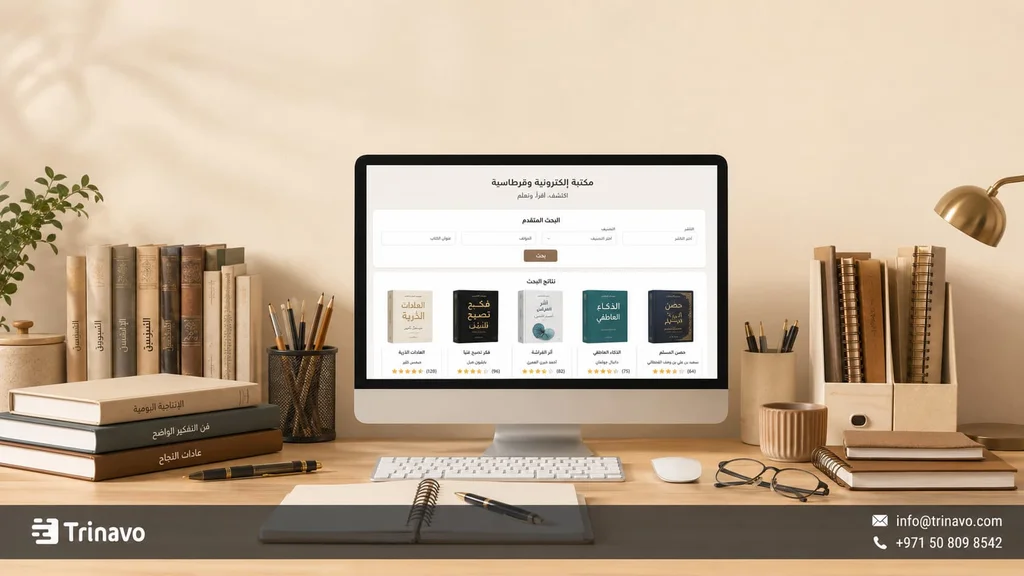
When creating an online stationery and bookstore, you must take into account that search is the heart of the experience. The customer may search by the book's title, author, publisher, category, language, age group, or even a general topic such as: books about money, science fiction novels, or children's books.
Therefore, each book's data must be organized precisely:
|
Data Element |
Example |
|
Book Title |
The book's name |
|
Author |
The writer's name |
|
Category |
Novel, business, children, education |
|
Language |
Arabic, English, other languages |
|
Publisher |
The publisher's name |
|
Age Group |
Children, teens, adults |
|
Product Type |
Print, digital, audio |
|
Tags |
Investment, self-development, education, fiction |
|
Number of Pages |
300 pages |
|
Year of Publication |
The release year |
The more organized this data is, the easier the search and filtering experience becomes, and here lies the power of Trinavo, which gives you integrated tools to manage products, categories, and inventory, helping you build an organized and attractive catalog that accommodates thousands of books and stationery items easily and clearly
Information-Rich Book Pages
The reader can't try a book the way they try a physical product, but they can read a brief description, an author bio, a table of contents, a permitted excerpt, or reviews from previous readers.
Therefore, the book page should contain:
- A clear, brief description.
- An author bio.
- Category and language.
- Number of pages.
- Edition type: print or digital.
- Publisher and release year.
- Who is the book suitable for?
- Reader ratings and reviews.
- Similar books or books by the same author.
As for stationery products, you should clarify the number of pieces, size, material, color, use, and packaging or quantity options.
The SEO tools and AI in Trinavo help improve book and product descriptions, making store pages clearer for the customer and more discoverable in search engines.
Recommendations That Help the Reader Discover
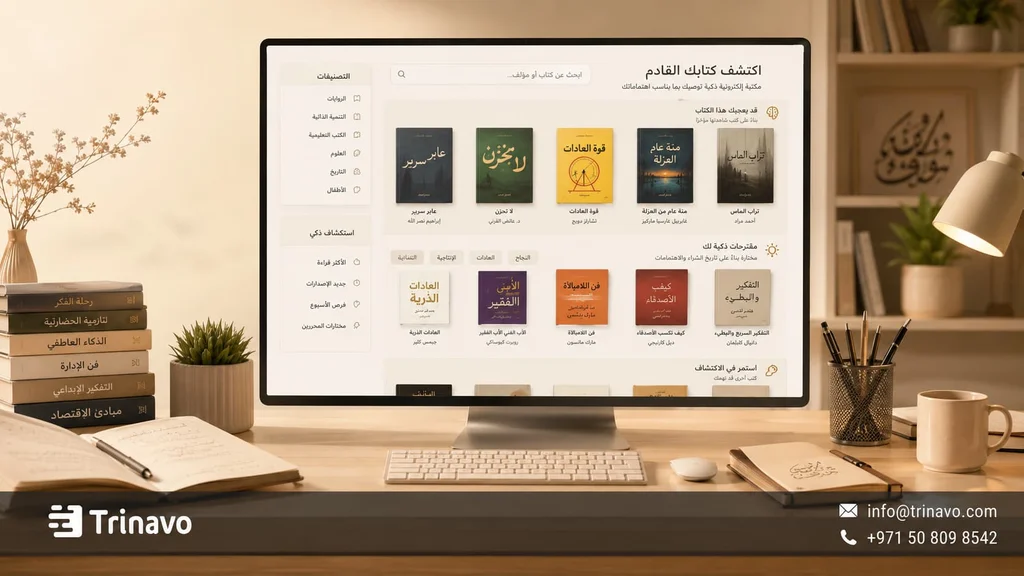
Recommendations are very important in a bookstore, as a reader who buys a detective novel may be interested in similar novels, and someone who buys planning notebooks may be interested in pens, stickers, and organizers.
You can use recommendations such as:
|
Recommendation Type |
Example |
|
Similar Books |
Because you browsed this book |
|
By the Same Author |
Other books by the same writer |
|
From the Same Category |
More fiction novels |
|
Bought Together |
Book + bookmark + notebook |
|
Best Sellers |
Trending books this week |
|
For Students |
Back-to-school books and stationery |
And Trinavo's analytics help Trinavo understand customer behavior and identify which products are viewed or added to the cart most, supporting better recommendations and increasing the average order value.
Categories Built on Reader Intent
It's not enough to divide the store into books and stationery; it's better for categories to be close to the customer's way of thinking.
You can create categories such as:
- Novels.
- Children's books.
- Self-development books.
- Management and business books.
- Religious books.
- Educational books.
- University books.
- E-books.
- School stationery.
- Office stationery.
- Notebooks and planners.
- Gifts for readers.
- Back-to-school offers.
This organization makes the store more browsable and supports visibility in search results when using terms like online bookstore or online stationery shop.
Steps to Create an Online Bookstore and Stationery Shop with Trinavo
Creating a successful books and stationery store doesn't start only with adding products, but with building a clear system to manage titles, organize inventory, simplify purchasing, and prepare an experience that suits the reader, the student, and the office owner at the same time.
With Trinavo, you can start with a simple store, then develop it gradually as the number of books, orders, and products grows.
1 . Create Your Store Easily and Start with the Basic Settings
Start by opening an account on Trinavo and creating your online store in a few simple steps, without needing technical expertise or complex setup. The platform lets you start with a free store and doesn't require a credit card to get going, which makes it a suitable choice for small bookshops, publishers, and stationery stores that want to try online selling before expanding.
After creating the account, set up the store basics such as the brand name, language, currency, contact details, and selling and shipping policies. Then move on to customizing the storefront and adding your first collection of books or stationery products.
2 . Start with a Small, Organized Catalog
You don't need to upload hundreds of books from the start. It's better to begin with a curated selection that clearly represents the store's identity, such as children's books, novels, self-development books, school stationery, or reader gifts.
Start with a limited number of products, then monitor demand. This approach helps you learn what customers actually look for and reduces clutter in inventory management.
For example, the start could be:
- 30 of the most in-demand books.
- 20 essential stationery products.
- 5 ready-made bundles for school or gifts.
- A small set of digital books if the rights are available.
3 . Prepare a Unified Data Template for Products
So the store doesn't turn into a random catalog, set a fixed template for adding products, with a slight adjustment by product type.
The template could rely on the following fields:
|
Product Type |
Key Data |
|
Selling Books Online |
Title, author, language, publisher, edition type, number of pages, category, availability status |
|
Selling Stationery Online |
Product name, size, color, material, number of pieces, use, availability status |
|
Other Products |
Product type, contents, suitable category, size or dimensions, packaging or customization options |
This organization makes catalog management easier and helps the customer compare and choose without confusion. And as the number of products grows, Trinavo helps you—through product and inventory management—maintain a clear arrangement and update availability status accurately
4 . Arrange Products into Sellable Bundles
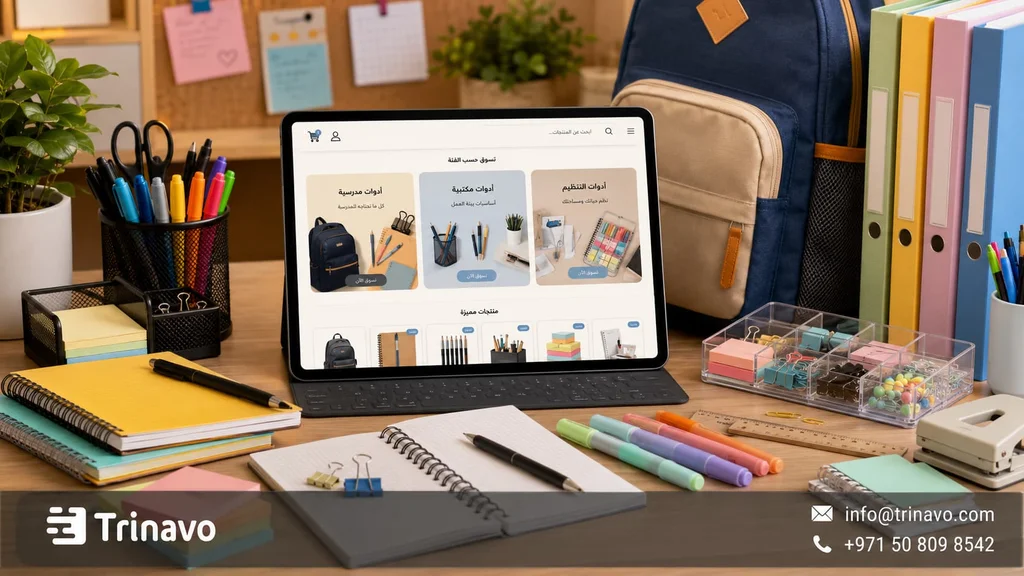
Instead of displaying each item alone, group homogeneous products into smart bundles. A reader may buy a book with a bookmark and a notebook, and a student may need notebooks, pens, and folders in one order.
You can create bundles such as:
|
Bundle |
Its Contents |
|
Start of the School Year |
Notebooks, pens, folders |
|
Reader Gift |
A book, a bookmark, a small notebook |
|
Children's Books |
A set of books by age |
|
Organized Desk |
Paper organizer, pens, folders |
|
Weekend Reading |
A short book with a notebook |
This approach gives your store a greater ability to sell and contributes directly to raising the average order value without having to offer large discounts that eat into your profit margin.
5 . Set Up Payment and Shipping Before Launching the Store
In a books and stationery store, the delivery method isn't the same for all products. Printed books need shipping and packaging that protects the cover and corners, stationery needs good arrangement inside the parcel, while digital products need a clear electronic delivery path after payment.
Therefore, before launching the store, define how to handle each type of product:
|
Product Type |
What to Clarify for the Customer |
|
Printed Books |
Delivery time, shipping cost, packaging method, replacement policy for damage |
|
Stationery and Office Supplies |
Number of pieces, packaging method, shipping time, free shipping if available |
|
Cultural Gifts and Bundles |
Bundle contents, packaging style, ability to add a message, preparation time |
|
Digital Products |
That delivery happens electronically after payment, guiding the customer to the download details on the product page |
|
Mixed Orders |
Clarifying that digital products are delivered electronically, while printed products or stationery are shipped separately |
It's important that payment options suit the nature of the product. Electronic payment suits digital products because it makes completing the order and delivering the file easier, while other options such as cash on delivery can be offered for printed books and stationery depending on the store's policy and target market.
And Trinavo helps—through order management, payment gateways, and inventory tracking—organize this process, so the store owner knows the status of every order, and the customer knows whether they'll receive their product via shipping, download, or both.
6 . Set Up a Clear Method for Digital Books
If you're going to sell digital books, don't display them the same way you display printed books. The digital product needs clear information before purchase, because the customer isn't waiting for shipping—they want to know how they'll get the file, and what they're entitled to use after payment.
Clarify on the product page:
- The file format: PDF, EPUB, or other.
- The delivery method after payment.
- Can the file be downloaded immediately?
- Is there a set period or number of downloads?
- Is the file suitable for mobile, computer, or e-reader?
- Usage rights: personal reading, educational use, or a specific license.
- The return policy for digital products.
It's important not to sell digital books or files unless you own the rights to sell or distribute them. This point protects the store legally and preserves the trust of customers and publishers.
This type of product can be distinguished within the store with separate categories such as:
- PDF books.
- Digital educational books.
- Downloadable summaries.
- Guides and training files.
Learn more about the mobile apps Trinavo offers
7 . Launch the Store with a Season or a Clear Idea
Instead of launching the store generically, tie it to a clear idea that helps customers understand it quickly. For example: back to school, summer books, reader gifts, children's books, or a self-development library.
This kind of launch makes the marketing message stronger and makes preparing the homepage, offers, and content easier.
You can start with a campaign such as:
- Get the school bag ready.
- Books for your child by age.
- A reading bundle for the start of the month.
- Gifts for book lovers.
- Stationery for a more organized desk.
And the coupons tool in Trinavo helps track the performance of these campaigns and learn what's worth repeating or improving.
8 . Develop the Store Based on Customer Behavior
After launching an office supplies store, don't rely on personal impression alone. Monitor what customers buy, what they add to the cart, what runs out of stock quickly, and what doesn't achieve sales despite appearing in the store.
This data helps you make better decisions, such as increasing the stock of certain books, improving the descriptions of specific products, creating new bundles, or removing products that don't generate enough demand.
And with Trinavo's analytics, you can track the performance of products and orders, and develop the store gradually based on what customers actually request.
Why Is Trinavo Suitable for Books and Stationery Stores?
|
Books & Stationery Store Need |
What Trinavo Provides |
|
Launch the store quickly |
Free plan and e-commerce features |
|
Organize books |
Product and category management |
|
Sell varied products |
Books, stationery, printed materials, gifts |
|
Track availability |
Inventory management and tracking |
|
Improve visibility |
SEO tools and AI |
|
Manage orders |
Track order status |
|
Sell in different languages |
Language support and RTL interface |
|
Expansion |
Currency support and growth options |
|
Track performance |
Analytics and reports |
Whether you're a small bookshop owner, a publisher, a stationery store, or a project specialized in digital books, Trinavo helps you build a clear, easy-to-use store
Practical Ideas to Increase Books and Stationery Store Sales
Don't rely only on displaying books and products. Turn the store into a complete discovery and shopping experience.
|
Idea |
How to Apply |
|
Reading lists |
Curated books each month by category |
|
Bundles by age |
Children's books by age stage |
|
Reader gifts |
A reading box with a book, bookmark, and notebook |
|
School offers |
Stationery bundles for students |
|
Office offers |
Office supplies in bulk |
|
Reader reviews |
Detailed ratings that aid the decision |
|
Educational content |
Articles such as the best self-development books |
|
Pre-order |
Opening orders for new releases |
|
Similar recommendations |
Books by the same author or category |
The more you make the store help the reader discover, the greater the chances of their return and repeat purchase.
With Trinavo, Selling Books and Stationery Starts with a Clear, Organized Experience
Creating an online bookstore and stationery shop needs more than displaying covers and prices. It needs smart categorization, clear search, accurate data, convincing descriptions, trustworthy reviews, safe shipping, and an experience that makes the reader enjoy discovery.
Books aren't ordinary products; every title needs context, a recommendation, and a reason to buy. And stationery isn't just tools, but products tied to study, work, organization, and gifts.
And with Trinavo, you can create an online books and stationery store that manages products, inventory, orders, offers, languages, currencies, and analytics from one place, to build a buying experience that makes the reader come back to discover more.
Frequently Asked Questions About Creating an Online Bookstore and Stationery Shop
Can PDF e-books be sold alongside printed books?
Yes, e-books can be sold alongside printed books, but you must own the digital selling rights or be the authorized publisher or distributor. It's important to clarify the file format, download method, number of downloads if any, and the return policy for digital products.
How do I manage book shipping at a reasonable cost?
Start by dividing shipping by weight and regions. Books can become heavy when buying more than one title, so you can offer free shipping above a certain threshold to encourage the customer to increase their order. Use packaging that protects the corners and cover, and monitor the cities with the highest demand to improve shipping cost there.
What's the best way to display book reviews?
Make reviews detailed, not just stars. Ask readers to write what they liked, who they'd recommend the book to, and whether it suits beginners or advanced readers. You can also add a section like “Books our customers loved” or “Readers' picks”.
How do I increase stationery store sales?
Focus on seasonal bundles such as back to school, office offers, planning notebooks, organizing tools, and reader gifts. You can also use quantity discounts to raise the average order value.
Can a small bookstore compete with large stores?
Yes, but not by selling everything. It's better to specialize in a clear category such as children's books, Arabic books, business books, educational books, or creative stationery. Specialization, good recommendations, packaging, and useful content may be stronger than size.
Is Trinavo suitable for publishers and small bookshops?
Yes, because Trinavo helps manage products, orders, inventory, analytics, languages, and currencies from one place. You can also start with a small catalog and then expand gradually based on the number of titles and orders.


